
Jonathan Clark
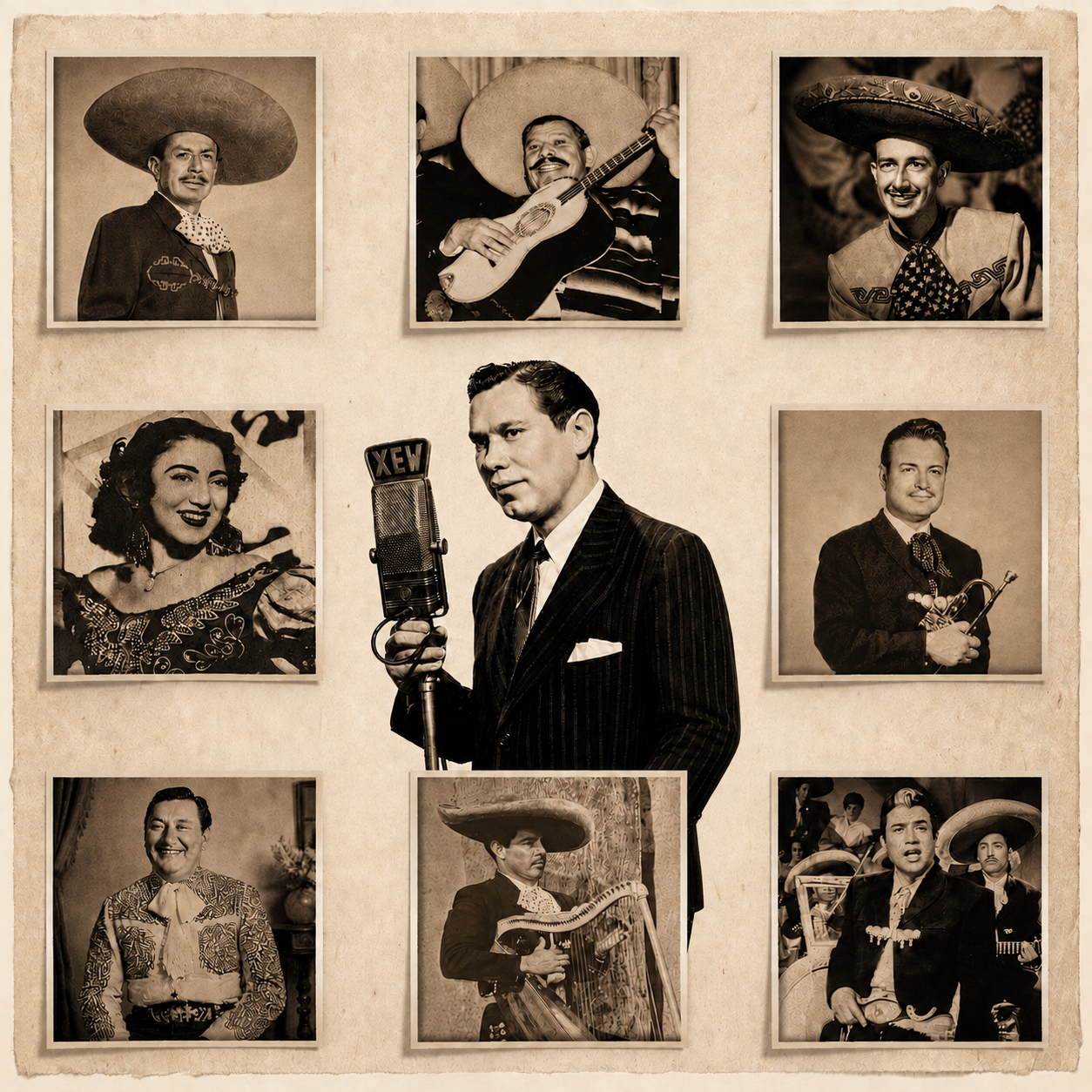
Anyone who has conversed with older mariachi musicians has certainly heard stories of the days when radio was king (c.1930–1960) — a period when in-person, live broadcasts featuring the finest musicians and vocalists of the era were an everyday occurrence in Mexico.
Our knowledge of this tradition is mainly limited to historical descriptions and still photographs of those live programs, since very few audio recordings of such transmissions survive. While it’s estimated that over 100,000 recordings of U.S. old-time radio programs exist today, Mexican programs from the same period are relatively scarce, and those featuring mariachis are among the rarest of all. Few of those programs seem to have been recorded in the first place, and most that did were apparently lost or destroyed or are in private collections not accessible to the public. The fact that the present program features several of the most important figures in the history of mariachi music lends even greater importance to this rediscovery.
Mexico’s most powerful and prestigious radio station of the golden era was undoubtedly XEW, “La voz de América Latina desde México.” One of that station’s most prolific and influential personalities was Álvaro Gálvez y Fuentes (1918–1975), affectionately known as “El Bachiller.”
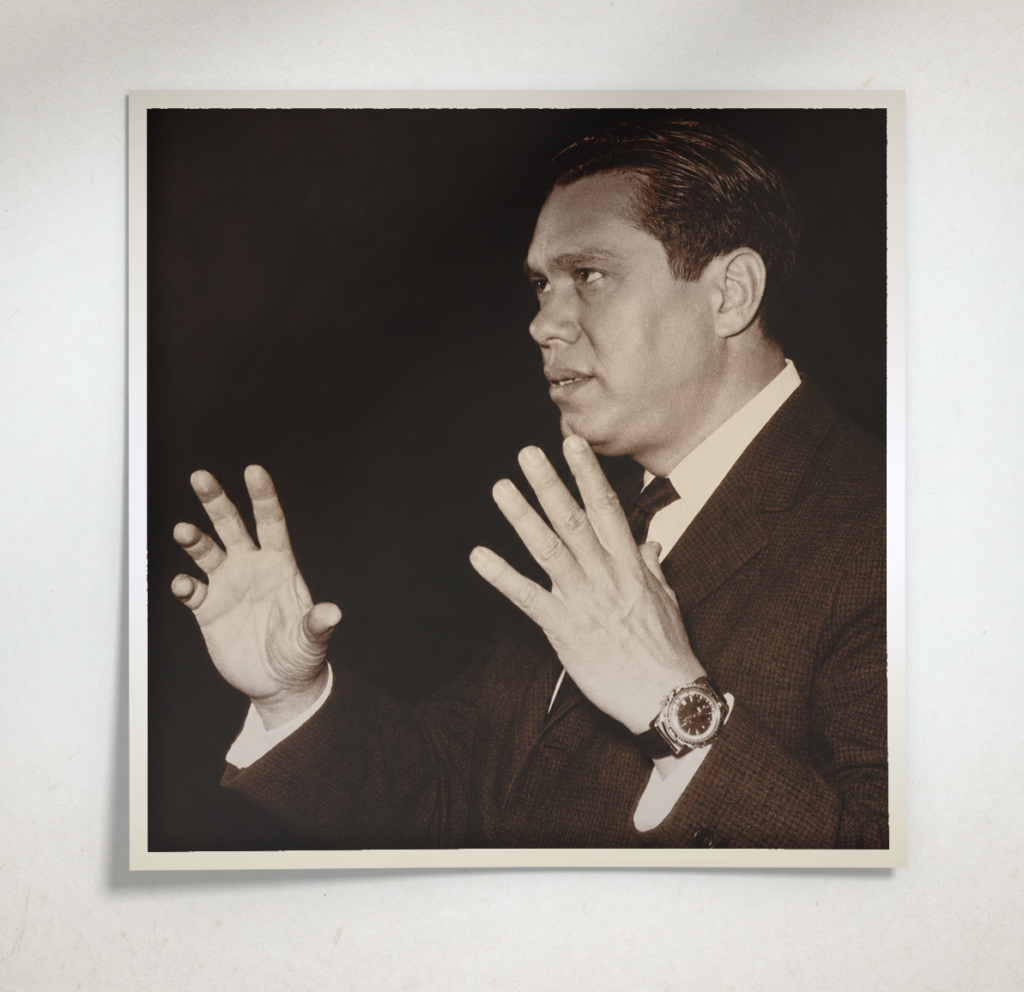
Álvaro Gálvez y Fuentes (Fonoteca Nacional de México)
As a radio announcer, multifaceted Gálvez y Fuentes was a charismatic and daring innovator who experimented with novel, state of the art techniques and concepts for his programs. Among the most innovative of these was Donde Menos lo Espere, a half-hour program broadcast every Friday evening at 8 pm. In this groundbreaking series, El Bachiller would take his portable tape recorder into the home of famous personalities whom he would interview over a backdrop of soundscapes that stimulated the mind’s eye in a manner more intense than cinema or television could achieve. While these programs were intended to evoke the ambience of a live, remote, on-location broadcast, in reality many were studio-edited sound collages created through the medium of magnetic tape, expanding upon techniques he had employed earlier using disc technology. Of this visionary series, the program most certain to interest mariachi fans is the 1956 episode titled “En la Casa del Mariachi Vargas.”

In late 1956, El Bachiller took his reel-to-reel recording equipment to the home of Silvestre Vargas, located at 52 Avenida Niños Héroes, in the Colonia Doctores neighborhood of Mexico City. In addition to convening his 11-piece mariachi for the gathering, Silvestre invited his father, Gaspar Vargas, who at that point no longer played with the group. Siblings Juan and Amalia Mendoza were included among the guests, as was Miguel Aceves Mejía. Silvestre’s brother, Amado Vargas, provided the birria. As best as can be ascertained, the following mariachi musicians participated, though not all were interviewed:
Miguel Martínez (trumpet)
Rubén Fuentes (1st violin)
Silvestre Vargas (1st violin)
Santiago Torres (2nd violin)
Rigoberto Pantoja (2nd violin)
José Contreras (3rd violin)
Heriberto Molina (3rd violin)
Gaspar Vargas (guitarra quinta)
Albino Pérez (vihuela)
Felipe Pérez (guitarra sexta)
Lino Briseño (guitarra sexta)
Gonzalo Meza (guitarrón)
Arturo Mendoza (harp)

Seated: Heriberto Molina, Santiago Torres, José Contreras, Lino Briseño, Gonzalo Meza, Felipe Pérez.
Episode: “En la Casa del Mariachi Vargas”
Series: Donde Menos lo Espere


00:01 Introduction
1:50 Prologue by Bachiller Gálvez
After affirming that the mariachi is currently considered Mexico’s most emblematic musical tradition, Gálvez asserts that it is “a relatively young music, practically newborn” — a hypothesis few would venture to repeat now. He posits the question:
What are the mariachi’s origens? That’s something we came here to find out today.

03:40 Interview with Silvestre Vargas
03:58 Gaspar Vargas enters the conversation. Both father and son state that Mariachi Vargas was formed in 1896, in contradiction to official versions and to Silvestre’s own later testimonies, where he consistently gave the founding year as 1898.
Another important detail here is that Silvestre confirms he took over the leadership of his father’s mariachi in 1932, refuting certain implausible dates that have been circulating.
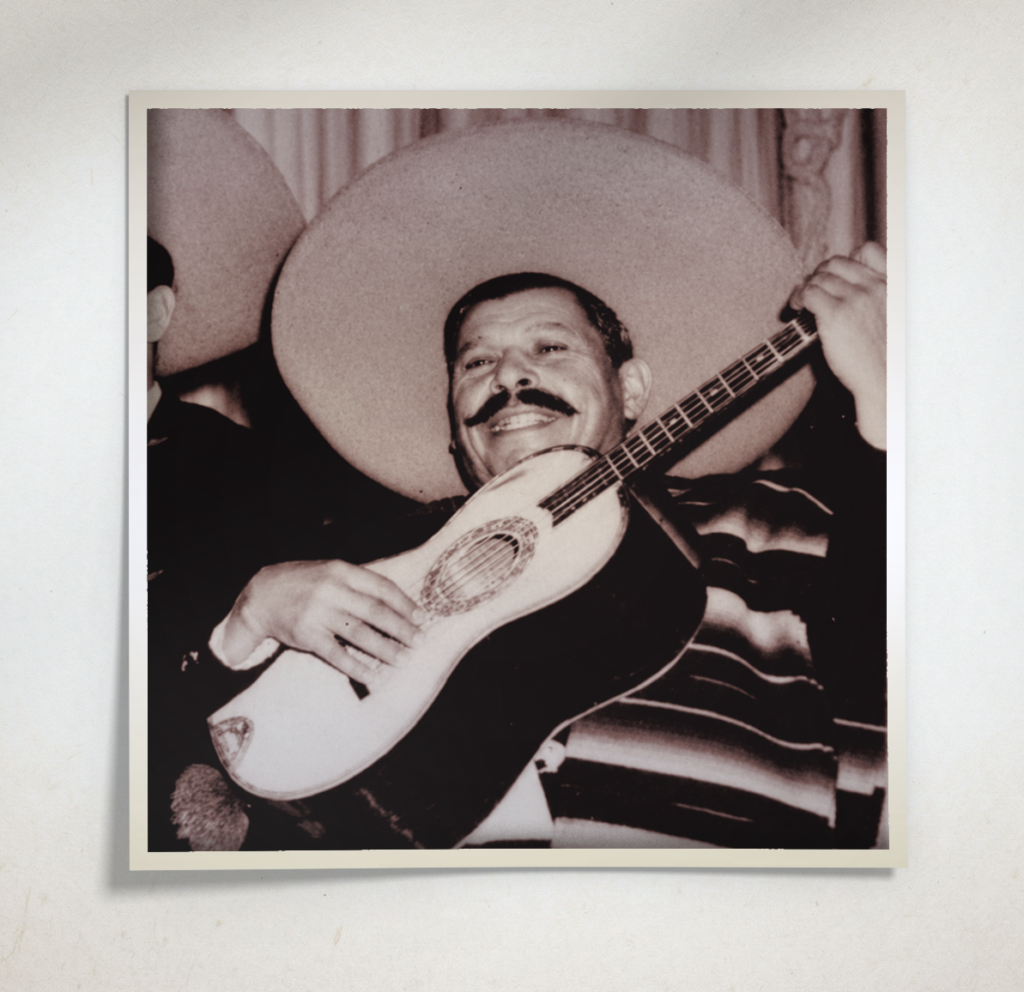
04:06 Gaspar Vargas assures Gálvez y Fuentes that they had never heard the word mariachi until their group arrived in Mexico City, and that back in Tecalitlán a mariachi group was known as a fandango. Although the word fandango can be used to denote the entire fiesta where mariachi music is performed, it appears that here Silvestre’s father refers to the musical ensemble. Note that Don Gaspar uses two distinct pronunciation variants in the same sentence: mariache and mariachi.
Bueno, los conjuntos de mariache no se nombraban mariachi. [Se nombraban] fandango. Aquí venimos a hallar el nombre de mariachi.
04:15 Bachiller Gálvez reiterates the obsolete belief that the word mariachi and its name are of French origin. Don Gaspar concurs.
Seventy years ago, when this program was recorded, the myth that the mariachi and its name were linked to the French Intervention (1861–1867) was so deeply established that even the most erudite individuals recited it as incontrovertible fact. To date, no evidence has been found to substantiate this claim, and that picturesque anecdote has since become a subject of mockery. Although the origin of the word mariachi continues to be debated, the tradition it represents undoubtedly dates back many centuries.
04:42 Gaspar Vargas affirms that his original fandango (mariachi ensemble) was comprised of two violins, guitarra de golpe, and harp.
It’s interesting to note that Gaspar Vargas was generally described by his contemporaries as a quarrelsome, belligerent individual who customarily toted a dagger and would brandish it at the slightest provocation. By contrast, in this program he comes off as well-mannered and jovial. Don Gaspar was 76 years old at the time of this recording. Perhaps he had become more easygoing with age.
05:00 Musical selection: “Jarabe Ranchero,” featuring the four previously mentioned instruments. The two violinists are most likely Silvestre and Santiago, both of whom had played together since the group’s rural days.

Trinidad Olivera, Silvestre Vargas, Manuel Mendoza, and Gaspar Vargas.
Fuente: La caravana Corona: cuna del espectáculo en México (México: Patentes y Marcas para Promoción de Exportaciones, 1995).
06:04 Silvestre explains the manner in which he eventually expanded his mariachi to include eight instruments: four violins, guitarra de golpe, guitar, guitarrón, and harp.
06:26 Musical selection: “El Cihualteco,” featuring the eight instruments that made up the group at the time they arrived in Mexico City in 1934.
07:30 Gálvez comments that two other instruments characteristic of the modern mariachi are still missing: the vihuela and the trumpet. Rather than presenting a corresponding example, a harp demonstration follows.
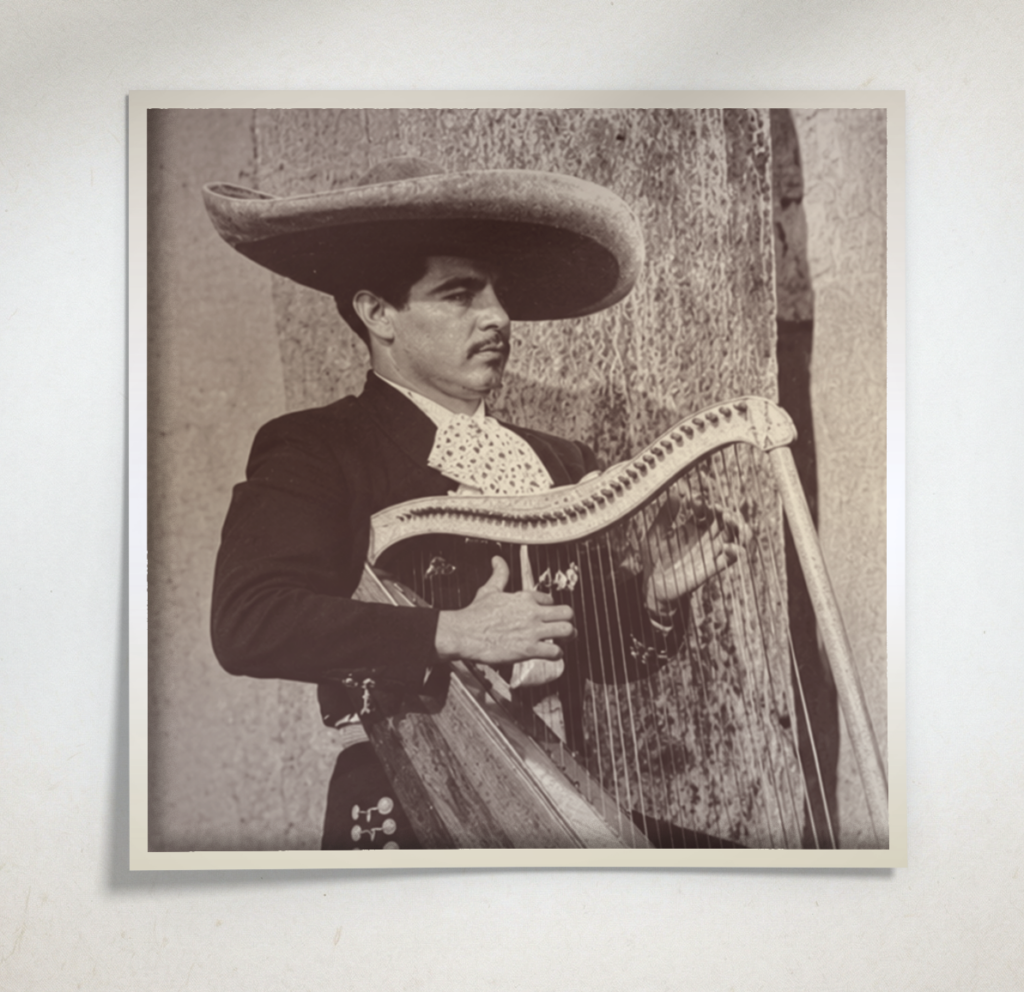
07:44 Musical selection: Arturo Mendoza plays solo harp on “El Jarabe Loco.”
This seems an ironic choice, being that “Jarabe Loco” doesn’t belong to the mariachi tradition. Nonetheless, Arturo plays the piece masterfully, indicating that by this point of time it had become a staple of his repertoire.
08:24 Musical selection: Gaspar Vargas demonstrates the guitarra de golpe or guitarra quinta.
08:55 Musical selection: “Son de la Negra,” featuring the complete ensemble.
At the time of this recording, “La Negra” was apparently considered the one selection most emblematic of mariachi music — as it remains today. (Vargas’s original trademark son had been “El Perico Loro”). “La Negra” originally had three verses, the third of which was eventually eliminated. The following link to Mariachi Vargas performing on French television in 1956 contains the lost verse, although this particular dub is highly accelerated and pitched a half-step high, disfiguring the rendition.

10:54 Monologue by Gálvez y Fuentes:
“This program evokes unique emotions. It’s as if — within the span of a half hour — we watched a child grow from birth to maturity, condensing many years into the space of just a few minutes. And it’s truly moving to witness how this simple rural tradition… has evolved into a music symbolic of Mexico—one that has conquered the major capitals of the world.”
11:23 Gálvez introduces Juan Mendoza, “El Tariácuri.”
11:58 Musical selection: the son “Bonito Tecalitlán,” interpreted by its author, Juan Mendoza.
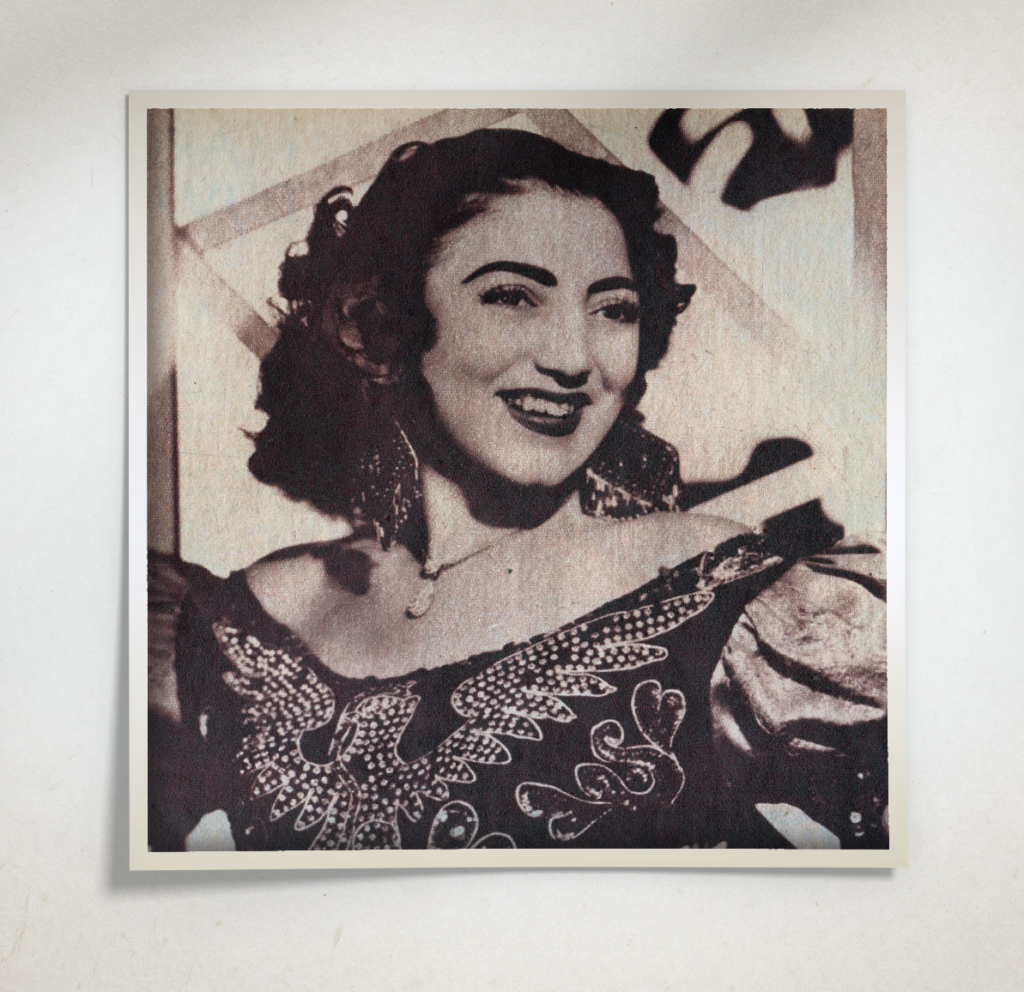
14:36 Gálvez introduces Juan’s younger sister Amalia, “La Tariácuri.”
15:38 Musical selection: Amalia Mendoza interprets the Tomás Méndez composition “Puñalada Trapera.” She affirms that this song had been her first hit recording.

7″ vinyl EP release from 1954
17:15 Gálvez asks Silvestre how the modern mariachi came into being. Vargas explains that the evolution began with Manuel Esperón, and was taken to greater heights by Rubén Fuentes.
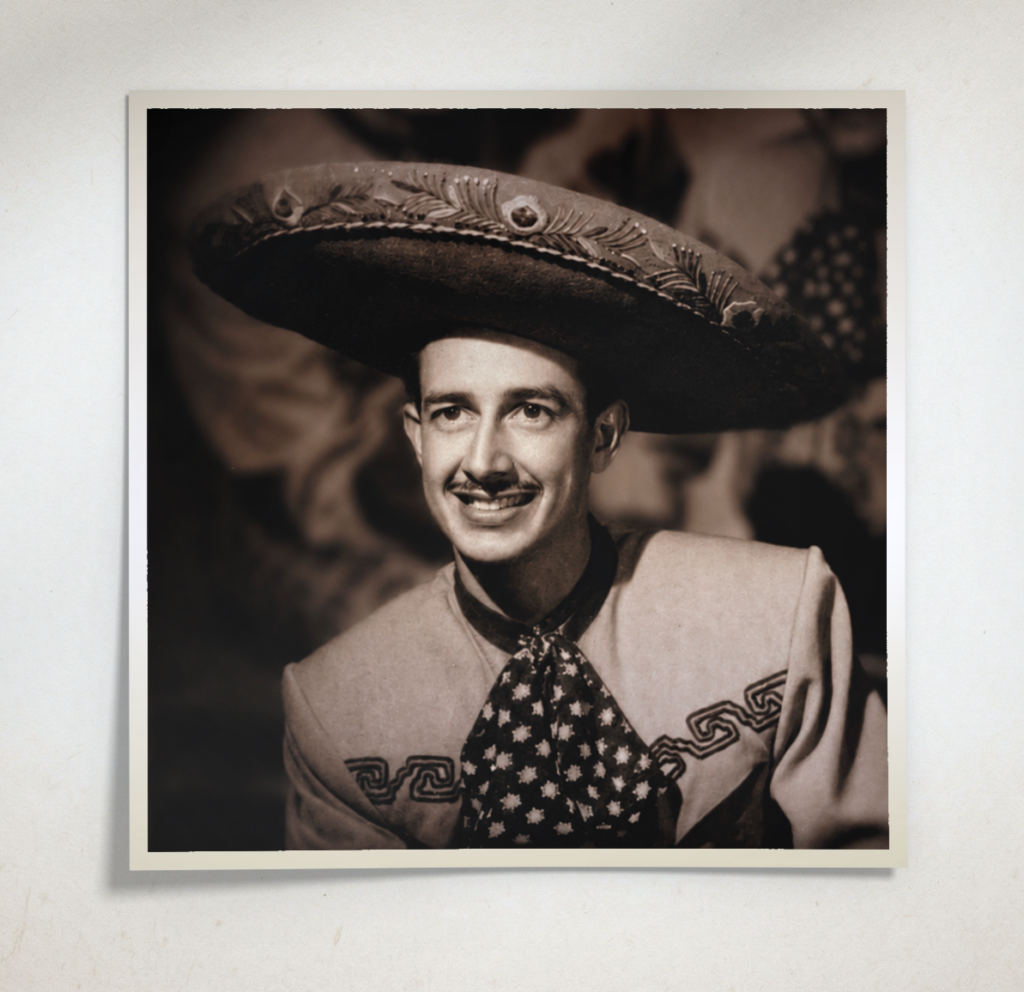
18:04 Rubén Fuentes enters the conversation. He affirms that his intention was to make the mariachi more attractive and sonorous, but without sacrificing its essence.
18:42 Silvestre confirms that his current group is comprised of six violins, two guitars, vihuela, guitarrón, harp, and trumpet.
18:58 Gálvez asks Silvestre how many groups named Mariachi Vargas he administrates. The rationale behind this seemingly odd question is that several months prior, contemporaneous photographs of Mariachi Vargas in France and in South America had been received by the Mexico City press. Journalists had cried foul, suspecting fraud.
19:00 Silvestre explains to Gálvez y Fuentes that he found it necessary to form a second-string Mariachi Vargas to accompany Miguel Aceves Mejía in South America while his first-string group was in France on a six-month engagement.

Silvestre did indeed direct two mariachi ensembles at that time: Mariachi Vargas de Tecalitlán and Mariachi Guadalajara de Silvestre Vargas. On occasions, he was even known to send out Mariachi Guadalajara as Mariachi Vargas. The two groups rehearsed together, and members of one group often reinforced the other when additional musicians were needed. Moreover, several musicians ascended from Mariachi Guadalajara to become formal members of the main Mariachi Vargas, further complicating the issue of group identity. During the same period, Pepe Villa also administrated two groups: Mariachi México and Mariachi Jalisco.

19:36 Gálvez interviews Miguel Martínez, who had been the designated leader of the contingent that went to France in Silvestre’s absence. Although the group remained in Paris for half a year (April through September of 1956), Miguel misstates that they had only been there for four months.

Martínez describes the enthusiastic reception with which Mariachi Vargas was embraced in Paris, and how they introduced a new modality of Mexican repertoire to the French public. Further description of this extended engagement can be found in his autobiography Mi Vida, Mis Viajes, Mis Vivencias (México, CONACULTA 2013). Miguel had great admiration for Bachiller Gálvez y Fuentes, and often mentioned him in conversations.

21:34 Lino Briseño sings “Mexico, Mexico!” from the French operetta Le Chanteur de Mexico. Mariachi Vargas participated in the film of the same name that starred Spanish tenor Luis Mariano. The mariachi can be heard briefly in the opening number.

Back row: Cástulo Briseño, Roque Castillo, Luis Navarrete, and Alfredo Serna.
Middle row: Mario Santiago, Silvestre Vargas, Salvador Padilla, and Santiago Torres.
Front row: Rubén Fuentes, unidentified, unidentified, and Miguel Aceves Mejía.
(All others are unidentified.)
24:20 Silvestre Vargas talks about the second-string Mariachi Vargas contingent he took to South America to accompany Miguel Aceves Mejía — an August through November 1956 tour of Paraguay, Uruguay, and Argentina — a sojourn that overlapped the Paris engagement of the first-string Mariachi Vargas.

24:44 Miguel Aceves Mejía enters the conversation and recalls some of his best-loved songs from that tour, including “Ella,” “Que Seas Feliz,” “La Noche y Tú,” “Rogaciano,” and “Tata Dios.”
24:58 Aceves Mejía affirms that to date he has made two tours to South America and the Caribbean. Gálvez y Fuentes 0bserves that prior to this, very few ranchera singers from Mexico had performed in those countries. Aceves confirms that Jorge Negrete had been there a decade earlier, accompanied by a trio [Trío Calaveras]. He considers himself the first to have brought a mariachi to those parts.
Gálvez y Fuentes asks Aceves how his music has been received in South America:
The fact that 70% of the music played in Buenos Aires and Uruguay is música ranchera mexicana tells you everything!
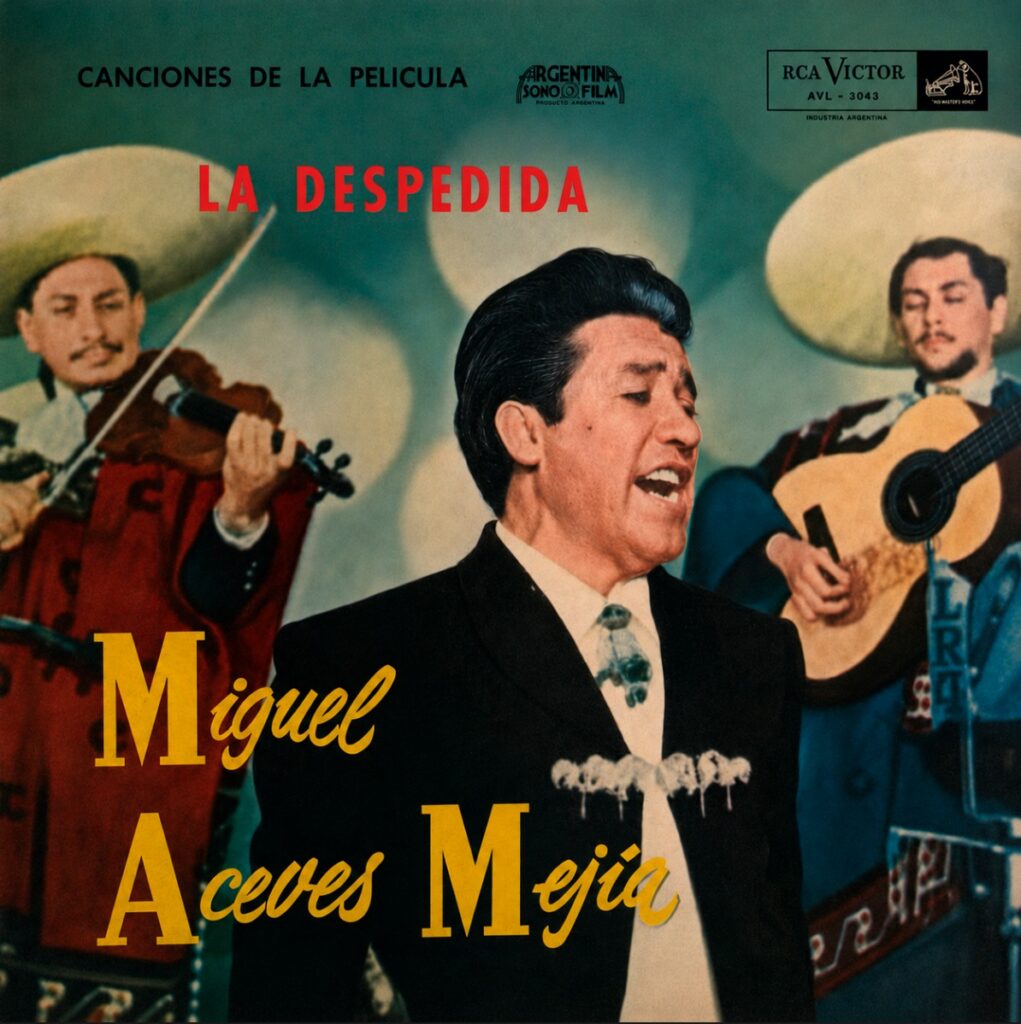
26:15 Gálvez asks Aceves if there are currently any South American mariachi groups. “They’re working on it, but it’s not possible,” concludes Miguel. When asked which of the songs he interpreted in South America had the biggest impact, Aceves replies unequivocally, “‘Ruega por Nosotros’, by Rubén Fuentes.” But when asked to sing, he chooses a different Fuentes composition:
28:28 Musical selection: “La Verdolaga,” huapango by Rubén Fuentes and Alberto Cervantes.
30:04 Epilogue by Álvaro Gálvez y Fuentes:
And so concludes this impromptu visit to the home of Silvestre Vargas—a visit that unexpectedly became a historical overview of mariachi music.
31:05 FIN
This radio series escaped the fate of most radionovela recordings, in part because Álvaro Gálvez y Fuentes maintained the rights to his productions and kept personal possession of his masters. For four decades following his death in 1975, his family preserved this priceless archive containing 1,354 sound recordings, which was eventually deposited in the Fonoteca Nacional de México. In 2021, UNESCO awarded the Memoria del Mundo de México designation to nearly 600 of these historical sound documents.
The rediscovery of these recordings coincides with a reevaluation of the many contributions of Álvaro Gálvez y Fuentes, who is perhaps best known today as the architect of Mexico’s national audiovisual education system. While recognized as a visionary pioneer media personality, most of the programs he produced between 1950 and 1975 have been unavailable for half a century, making that contribution relatively abstract and invisible to the general public.
Given the scarcity of radio transcriptions of this nature and severe copyright restrictions, it’s a minor miracle that this episode has survived and has finally been made available to the public. The original commercials, featuring the voices of Eva Garza and Salvador García, have been preserved intact. Although most of the musical selections here are highly truncated, as was common practice with such radio shows, this newly-rediscovered recording provides us with a rare window into mariachi music and live Mexican radio of yesteryear.

While you’re on the Musiteca website, check out some of the other interviews from the Álvaro Gálvez y Fuentes micro-site, including audio testimonies and performances from musicians such as Julián Carrillo, Agustín Lara, Trío Los Panchos, Pedro Vargas, and Consuelo Velásquez. And if it interests you, don’t overlook the Fonoteca’s other micro-sites for Carlos Chávez, Blas Galindo, Silvestre Revueltas, Diego Rivera, David Alfaro Siquieros, Emilio “El Indio” Fernández, Alfonso Reyes, and other Mexican luminaries.
About the Author
Jonathan Clark is a California-based mariachi musician who resided in Mexico for many years. Upon meeting Silvestre Vargas in 1978, he began researching the history of Mariachi Vargas. He personally knew most of the musicians featured in this radio interview. Clark has given many lectures at mariachi festivals in the U.S. and Mexico, and has published numerous articles on mariachimusic.com.
Special acknowledgments to Luis Jaime Chapa, Antonio Covarrubias, Pável Granados, Gilberto Mancilla, Margarita Sosa, and John Vela for their invaluable help with this article. Photos with provenance not specified are from the private collection of Jonathan Clark.






An excellent article by Jon Clark, a truly inspiring and enlightening mariachi historian. Jon has made a great impact on mariachi education with invaluable information presented in a unique and creative format. Thanks Jon!! Thanks, Cynthia, for including this historical research on your blog!
Mi estimado Jonathan, muchas gracias por este aporte tan valioso para el estudio del mariachi, nuestro símbolo musical por excelencia. Un fuerte abrazo desde Aguascalientes, México.
Es una joya que se debería difundir por todo el mundo. Es un privilegio el poder escuchar a los fundadores de una agrupación la cual es estándarte para todos los que nos dedicamos a la música del mariachi. Me siento afortunado de contar con la valiosa amistad que tengo con Jonathan Clark y el haber trabajado juntos. Como también así, la del Mariachi Vargas de Tecalitlán, desde la cuarta generación hasta la actual. Gracias por permitirnos disfrutar de tan emotiva entrevista y poder escuchar al Vargas de ese entonces, que fue el papá de todos los grupos de la época.
Me parece buen trabajo de investigación. En su desarrollo, parece que estuviera hecho por un mexicano. Es un texto hecho con conocimiento y con pasión por la música que nos ha dado identidad. Hace falta mucho más trabajo de investigación, de fortalecimiento de archivos y de divulgación.
Sigue adelante, Jonathan. Gracias por tu trabajo.
Abrazote
Excelente trabajo como siempre. Muchas gracias por todo el aporte tan importante para la música de mariachi.
Un fuerte abrazo desde Guadalajara, Jalisco.
09 junio 2026
¡Gracias por compartir este tesoro histórico de nuestra música ranchera!
Mucha educación y eficaz. ❤️
Gracias por la aportación, maestro.
Saludos desde Guadalajara, México.
¿Quién mejor que tú, mi Johnny querido, para realizar algo tan excelente? Felicidades.
Muy interesante. Gracias por compartir. ¡Me encantó!
Gracias, mi buen amigo Jonathan. Saludos y abrazos desde Tecalitlán, tu pueblo adoptivo….
Interesantísima todo la información!!! ¡Gracias, Joni!
¡Qué joya Johnny! Y qué bonito se escucha el mariachi. ¡Buenísimo!
Muchísimas gracias Jonatan. Gracias por compartir con nosotros. Te mando muchas bendiciones. “El Pichi”, Felipe Pérez Jr
Magnífico artículo de nuestra música de mariachi. Qué interesante y muy completa toda la información.
¡Muchas felicidades, Jonny!
Jonathan, mil gracias por compartir y ayudarnos a conocer estas joyas legendarias.
Joni, eres increíble!
¡Interesantísimo! Sigue compartiendo esas joyas.
¡Muchas gracias, maestro!